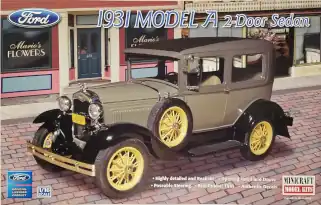
I decided to mix my own colors for this build. Figure 01,
from the instruction sheet shows the color's used in
different area's of the body.
Light Blue
1-part Tamyia X-4 Blue, 3-parts Tamyia X-2
Dark Blue
2-parts Tamiya X-16 Purple, 3-parts Tamiya X-3 Royal Blue
Dark Purple
3-parts Tamiya X-16 Purple, 3-parts Tamiya X-3 Royal Blue
1 -part Tamiya X-1 Black, 1-part Tamyia X-4 Blue
Long-grain leather roof
Tamiya xF-1 Flat Black
Engine block, valve cover, transmission and water pump
Vallejo 71.043 US Olive Drab
Engine components
Tamiya X-1 Black
Notes
When assembling the engine, the valve cover did not fit well. It was
extending beyond the engine block. I started standing and filing to
make it fit, but I finally realized that the valve cover was not
square to begin with. So...either the corner of the cover would
slightly extend over the block, or the top edge of the block would be
exposing the top edge of the block. I chose to have the valve cover
slightly hang over the corner of the block.
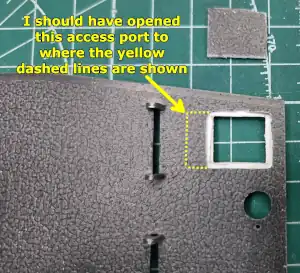
Figure 02 - Battery Access Port
The interior floor should have had a battery access panel, otherwise,
when the battery is installed it would never be seen again. I cut
an access panel, albeit a bit small, it does have a panel that lifts
out to show the battery.
I could not locate any 1:12 scale battery cable lugs; therefore, I
made my own using K&S Precision Metals 898775 0.125"/3.175mm aluminum
tube #5100. I simply cut two pieces approximately 1mm to 1.5mm high,
than drilled the hole to 1.0mm. The 1.0mm hole perfectly fit the
battery terminal. I then used some black insulated 24AWG (American
Wire Gauge) for the negative terminal and ran that to the starter.
(Model A's are positive ground). I than used a piece of copper strap,
1.0mm wide as the positive connection and glued one end to the
positive terminal of the battery and the other end to the cars frame.
The front seats do not fit well to the interior floor hinge posts.
The posts that are molded into the floor bend outward when the seat
hinges are placed into them. The seats tilt forward a little, but
not like I would have expected.
Figure 03 - Instruction Sheet Step 11
Refer to the letter reference designators in Figure 03 for the following text.
The hole in the inner hub was not drilled anywhere near the size required
for the axle. The axle measures 0.078"/1.98mm in diameter. I drilled both
inner hubs using a #47 drill (0.078"/1.98mm). That gave the axle a very
snug fit.
Part F13 made no sense to me? It didn't fit and if it's supposed to be a
end of exhaust pipe to dress it up, it didn't do a very good job of it. I
made a dress-up pipe from a piece of Evergreen 224 (0.125"/3.2mm) styrene
tube. I cut the tube 10mm long and painted it with Vallejo 77.723 Exhaust
Manifold.
The axle was way too long. The axle, out of the box, measured 3.62"/91.95mm
in length. Even after putting the inner wheel hubs on, there was at least
a 0.25"/6.35mm side to side play. I placed the rear wheel hubs on the rear
axle housing and then measured the length. With the inner wheel hubs in
place, the length measured 3.058"/77.67mm. I then cut the metal axle to
a length of 3.158"/80.21mm. That worked fine with next to no side-to-side
movement.
The hole that is in the chassis cross member that mounts the engine was
too small. I drilled that open with a #57 drill (0.043"/1.09mm). That
gave the engine pin a nice press fit.
DO NOT USE HAMMER
I'm not a hammer mechanic. Don't use a hammer of any size to fit the axle
into the inner hubs. Drilling the inner hub as described about, makes a
snug fit that get be pressed together with you fingers.
Figure 04 - Instruction Sheet Step 16
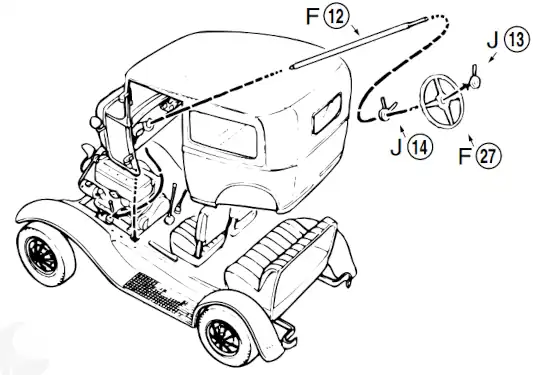
Refer to the letter reference designators in Figure 04 for the following text.
I lost part J3, one of the floor buttons. It was easily reproduced with
a piece of of wire for the shaft and a piece of styrene rod cut to length
and sanded round to the size. I then drilled a small hole in the styrene
rod for the wire, glued the wire into the rod and then glued the assembly
to the correct spot on the floor.
Part E5 (Reference A) was not drilled. I drilled the hole open with a
#55 drill (0.052"/1.32mm) large enough to fit the shaft of part F14.
There is no place referenced on the dash for gluing E5, so I simply
selected a spot and used Gorilla Glue Paste to glue it in place.
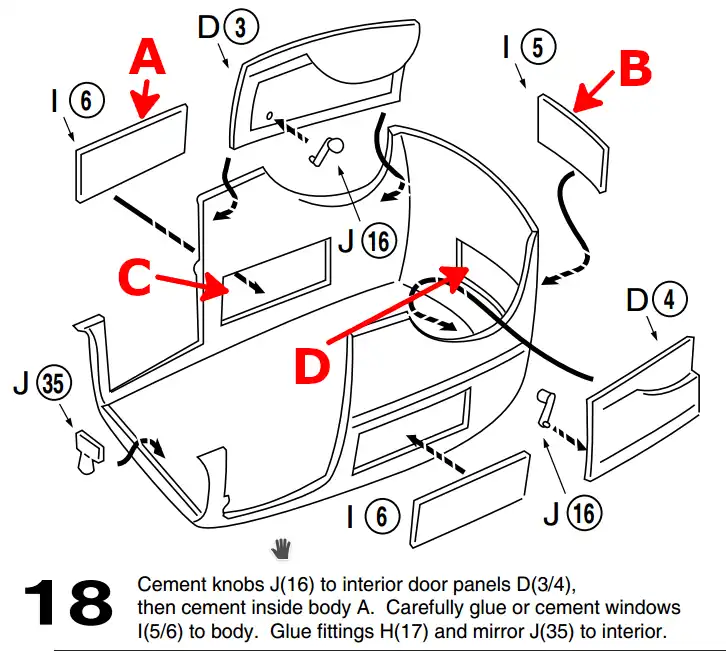
Figure 05 - Instruction Sheet Step 18
Refer to the letter reference designators in Figure 05 for the following text.
The side window glass (I6) is slightly too small for the openings in the
body. When placed in the opening there is not enough gluing surface. If
the glass is positioned in the designated framed area, there is an open
gap on two sides. After several attempts to hold it in place for gluing,
and failing every time, I decided to order some Evergreen 9007 Clear
Polystyrene (ordered 10/18/25) and make my own glass.
The back window glass (I5) is also slightly too small. The same as the
side glass.
The openings in the body for the side windows measure: 1.869"/47.47mm x 0.968"/24.59mm.
That measurement is the size of the mounting frame that is molded into the body.
The glass that came with the kit measures: 1.791"/45.49mm x 0.924"/23.47mm. As
you can see, the glass is smaller, in fact, the glass is almost the same size as
the opening in the body.
The opening in the body for the back window measures: 1.618"/41.09mm x 0.773"/19.63mm.
That measurement is the size of the mounting frame that is molded into the body.
The glass that came with the kit measures: 1.452"/36.88mm x 0.653"/16.59mm. As you can see,
the glass is smaller, in fact, the glass is almost the same size as the
opening in the body.
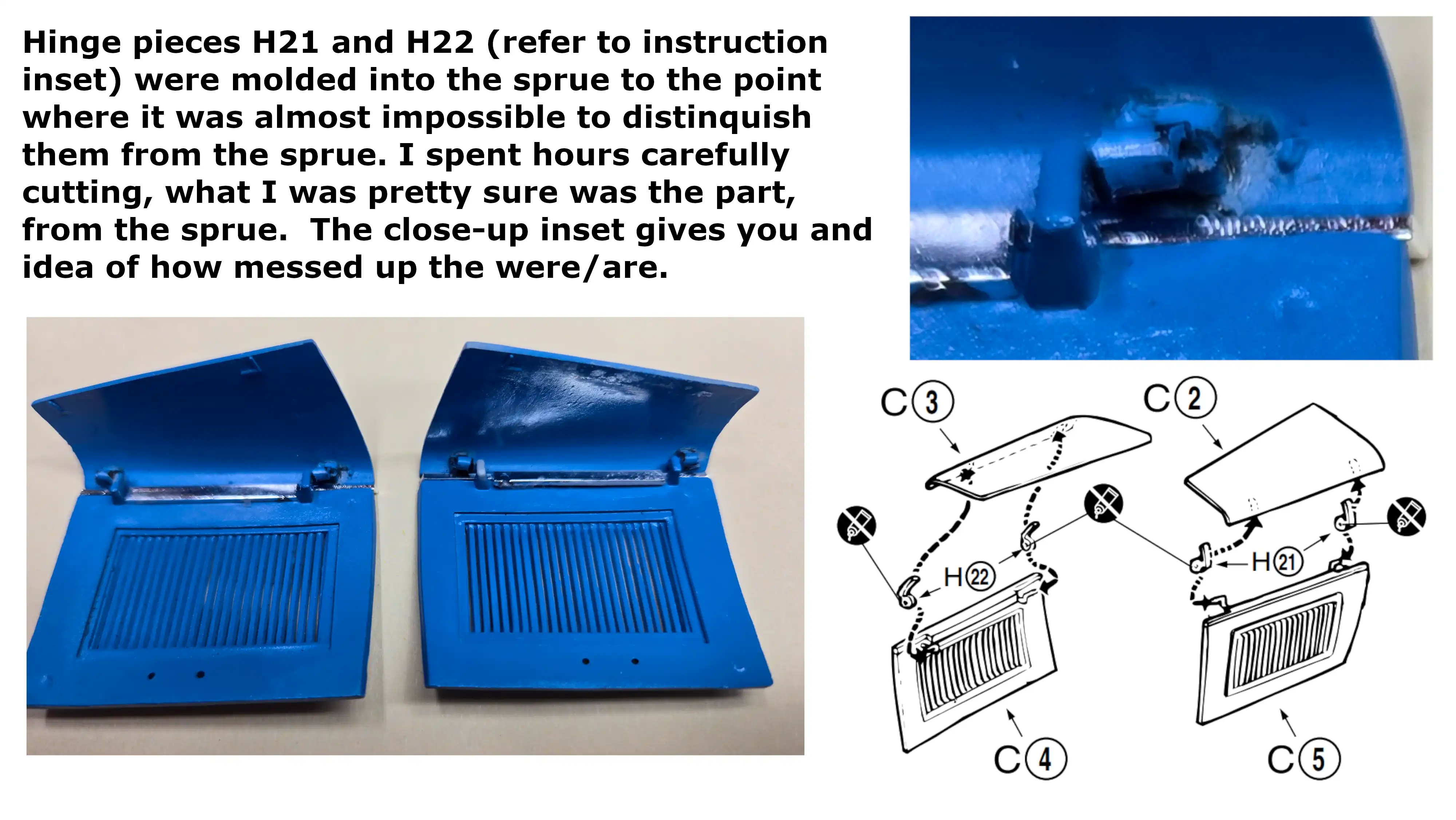
Figure 6 - Engine Shroud Side Hinges
Click the image to enlarge. Enlarged image will open in a new tab or window
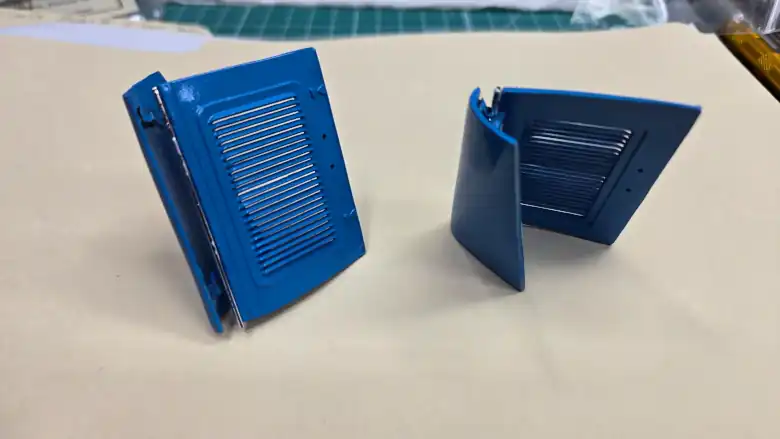
I didn't take a picture of the engine shroud side hinges while they were on the sprue;
however, they were molded into the sprue to the point where the small parts; H21 & H22
were hardly distinguishable from the sprue. After hours of trimming, cutting, filing and
sanding, I got the small parts the best they were going to be. I spent the time because
I wanted the engine shroud to work.
When the image above is enlarged, and you look at the inset in the upper right, it can
be seen how messed up the small hinge part is, even after cleaning the best it could
be cleaned and still keep it functional. I probably could have, and should have scratch
build new ones, but these did work.
Figure 7 - Engine Shroud Sides folded
I SURRENDER!!!
The next two problems are what made me surrender. I've already spent WAY too much time on this
kit and these next two items will take a lot more time.
I hate giving up because this is a really nice kit, but there wasn't one assembly section that I
did not have to make modifications and/or scratch build parts because the parts on the sprues
were misformed - I'm sure from old, bad molds.
Center Hinge on the Engine Shroud
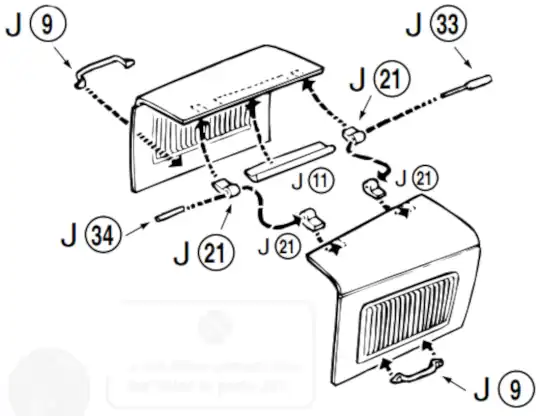
The center hinge on the engine shroud is assembled in a similar manner to the side hinges.
Figure 8 shows Instruction Sheet Step 25. Take particular notice to parts J21.
Figure 8 - Instructions Step 25 - Assembling the Engine Shroud Center Hinge
The 'J' numbers mean that these pieces are on the chrome tree. Figure 9 (a bit blurry 'sorry')
are parts J21 on the tree. They look like someone dripped hot solder on them. You can click the
image to make it larger. The large image will open in a new tab or window.
Figure 9 - Engine shroud center hinge parts J21 on the sprue
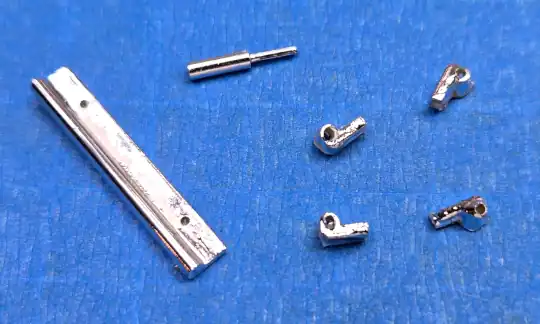
I spent hours cutting, filing, sanding drilling and shaping to extract the J21 parts from the
sprue. They were most likely not going to work, but I kept working because I really wanted the
engine shroud to open like it should. Figure 10 shows the parts after I salvaged them from
the sprue. They don't look too bad in the photo, but trust me, they're in bad shape.
Figure 10 - Engine Shroud Top Hinge Parts are Off the Sprue
Parts J21, J11 and J33, when stacked together are to form the engine shroud center hinge;
however, with all the parts stacked together, they still weren't long enough to fill the
length of the engine shroud. Besides, parts J21 are so bad I wasn't shure I could use them
at all. I was considering scratch building the entire hinge using some aluminum tube,
styrene blocks and wire from the hinge axle. To get started I placed the two halves of
the engine shroud on the firewall and positioned the radiator in position. This is when
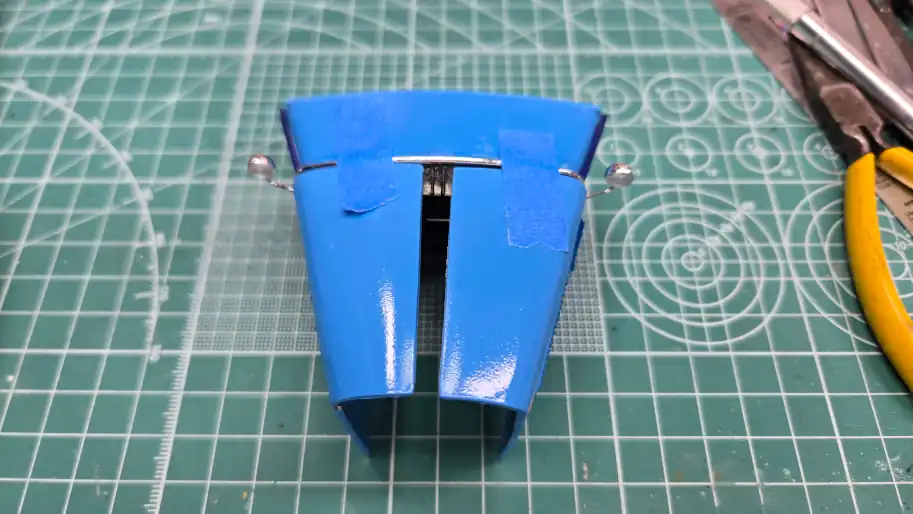
yet another disaster occurred. Figure 11 shows this disaster. When the two halves of
the engine shroud are in position, there is a huge gap between the two halves. I had not
previously dry fit this because without it being assembled it was difficult to properly
position the parts. I am/was so frustrated I put the assembly pieces aside and thought I'd
move on to placing the body on the frame. Maybe once the body is on the frame and the
car looks more complete, I'll get my energy back to figure out what to do with the engine
shroud problem.
Figure 11 - Hug Gap Between the Two Halves of the Engine Shroud
But This is what Derailed Me
After the debacles of the engine shroud hinges, I thought I would put it aside and move
onto putting body on the chassis. I thought, after all the time I had spent on this kit,
seeing the body in place would rejuvenate me.
I already assembled the radiator; therefore, I moved onto step 21, shown in Figure 12. I did not
put the gas tank/firewall on the body because of all the alignment issues I've been having. I
figured I would put that on after the body was in place, but not glued.
Figure 12 - Instruction Sheet Step 21 - Placing the Body on the Frame
The first thing I asked myself was, "How am I ever going to get this body to fit over the
back seat?" I've had to hold the body open on other models so I gently took the sided of the
body and started pulling them apart to fit over the rear seat. I then started to hear the
cracking of the glue bonds breaking that held in the rear interior side panels; and the body
was not ever close to fitting over the back seat. I paused and did some investigating as to
how this body was going to fit over that back seat? I tried again by spreading the sides of
the body apart, but it wouldn't spread wide enough to fit. I thought maybe I could place the
front of the body behind the rear seat than then slowly pull the body forward over the rear
seat. That did not work. I though about setting the body on at and angle and twisting it over the
rear seat. That won't work either.
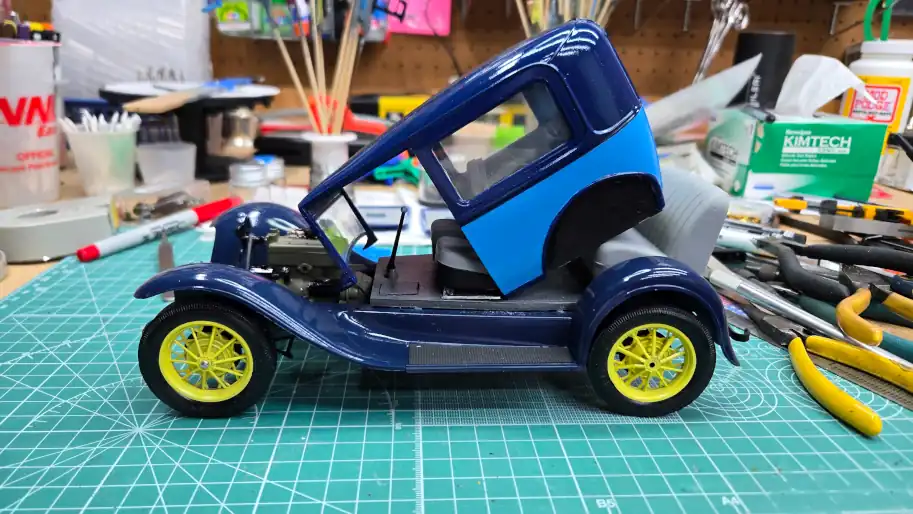
There was no way this body was going to fit over that rear seat. I knew I had problems fitting
the body in place while I was dry fitting, but it went into place. The difference was that when
dry fitting, I didn't have the inner rear door panels in place. Now...with them in place, this
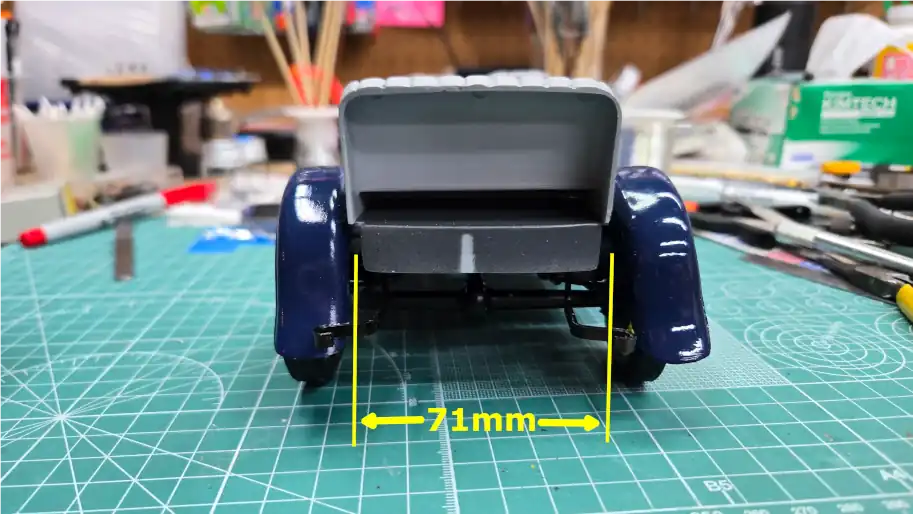
body was not going to fit. I made some measurements and Figure 13 & Figure 14 show that there
is no way this body was going to fit on the frame; at least no way I could figure out.
Figure 13 - Dimension Between the Rear Fenders
Figure 14 - Dimension Between the Rear Inner Door Panels
As you can see, there is no way this body is going to fit over the back seat.
So...I Surrender!!!
I'm reboxing this kit and moving onto the next project. Like I said...I've already spent
WAY too much time on this kit.
I might come back to it at a later date, because IT IS a really nice kit. But for now, IT WON!